# parallelStream
##
Stream/StreamparallelStream()stream().parallel()
Java API
- 1.0-1.4 java.lang.Thread
- 5.0 java.util.concurrent
- 6.0 Phasers
- 7.0 Fork/Join
- 8.0 Lambda
## parallelStream
`Collection`
```java
/**
* Returns a possibly parallel {@code Stream} with this collection as its
* source. It is allowable for this method to return a sequential stream.
*
* This method should be overridden when the {@link #spliterator()}
* method cannot return a spliterator that is {@code IMMUTABLE},
* {@code CONCURRENT}, or late-binding. (See {@link #spliterator()}
* for details.)
*
* @implSpec
* The default implementation creates a parallel {@code Stream} from the
* collection's {@code Spliterator}.
*
* @return a possibly parallel {@code Stream} over the elements in this
* collection
* @since 1.8
*/
default Stream parallelStream() {
return StreamSupport.stream(spliterator(), true);
}
```
`@return a possibly parallel`
parallelStream`ForkJoinPool`****
[Custom thread pool in Java 8 parallel stream](https://stackoverflow.com/questions/21163108/custom-thread-pool-in-java-8-parallel-stream)
> The parallel streams use the default`ForkJoinPool.commonPool`which[by default has one less threads as you have processors](http://docs.oracle.com/javase/8/docs/api/java/util/concurrent/ForkJoinPool.html), as returned by`Runtime.getRuntime().availableProcessors()`(This means that parallel streams use all your processors because they also use the main thread)
```java
public static void main(String[] args) {
IntStream list = IntStream.range(0, 10);
Set threadSet = new HashSet();
//
list.parallel().forEach(i -> {
Thread thread = Thread.currentThread();
System.err.println("integer" + i + "" + "currentThread:" + thread.getName());
threadSet.add(thread);
});
System.out.println("all threads" + Joiner.on("").join(threadSet.stream().map(Thread::getName).collect(Collectors.toList())));
}
```
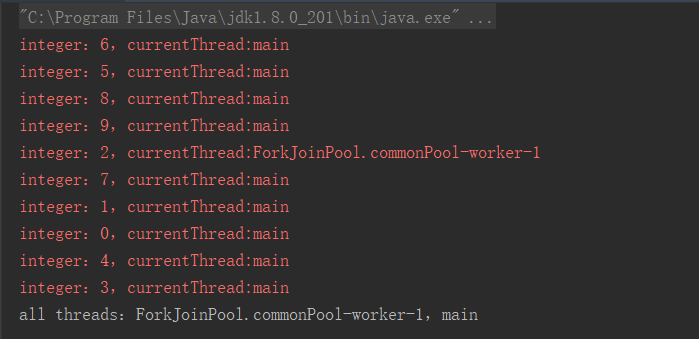
 [13932958-263c866e35df81e5.png]
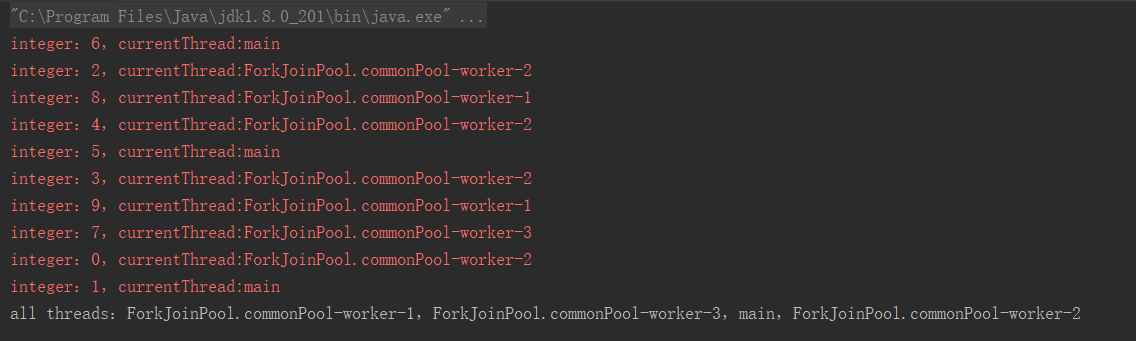
parallelStream`ForkJoinPool.commonPool`
 [13932958-e1836ce1a66f41ec.png]
java 8
> `ForkJoinPool`7.2/`Runtime.getRuntime().available- Processors()` `java.util.concurrent.ForkJoinPool.common. parallelism` `System.setProperty("java.util.concurrent.ForkJoinPool.common.parallelism","12");` `ForkJoinPool`
```java
//
System.setProperty("java.util.concurrent.ForkJoinPool.common.parallelism", "12");
System.out.println(ForkJoinPool.getCommonPoolParallelism());// 12
System.setProperty("java.util.concurrent.ForkJoinPool.common.parallelism", "20");
System.out.println(ForkJoinPool.getCommonPoolParallelism());// 12
```
`java.util.concurrent.ForkJoinPool.common.parallelism`finalJVM`ForkJoinPool`
```java
IntStream range = IntStream.range(1, 100000);
// parallelism
new ForkJoinPool(parallelism).submit(() -> range.parallel().forEach(System.out::println)).get();
```
parallelStream**parallelStream**IOparallelStreamparallelStream
> Using a ForkJoinPool and submit for a parallel stream does not reliably use all threads. If you look at this ([Parallel stream from a HashSet doesn't run in parallel](https://stackoverflow.com/questions/28985704/parallel-stream-from-a-hashset-doesnt-run-in-parallel)) and this ([Why does the parallel stream not use all the threads of the ForkJoinPool?](https://stackoverflow.com/questions/36947336/why-does-the-parallel-stream-not-use-all-the-threads-of-the-forkjoinpool)), you'll see the reasoning.
```java
// CPU
System.out.println(Runtime.getRuntime().availableProcessors());// 4
// parallelStream
System.out.println(ForkJoinPool.getCommonPoolParallelism());// 3
```
parallelStreamCPU1CPU
```java
static final int MAX_CAP = 0x7fff; // max #workers - 1
//
public ForkJoinPool() {
this(Math.min(MAX_CAP, Runtime.getRuntime().availableProcessors()),
defaultForkJoinWorkerThreadFactory, null, false);
}bs-channel
```
## parallelStream[Fork/Join ](https://www.infoq.cn/article/fork-join-introduction/)
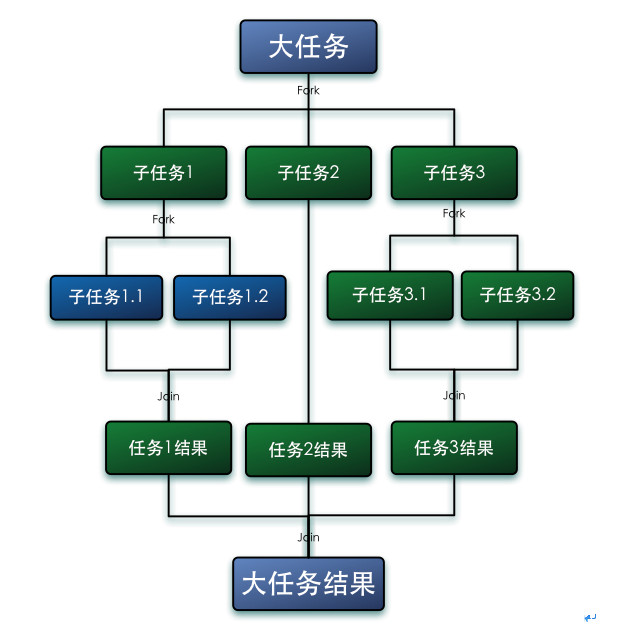
Fork/Join
- Fork/Join
 [13932958-dbceae46ea7c15c3.png]
Collector*supplier*,*accumulator**combiner*
-
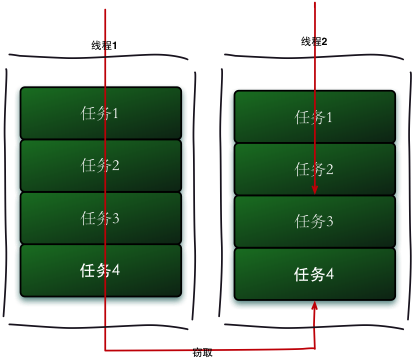
Fork/Join,CPU,cpu,work-stealingFork/Join,work-stealing
 [13932958-ffe0d5ddd7101bbc.png]
## parallelStream
parallelStream
1) lambda
2) (forkAndJoin)
[-CPU](https://blog.csdn.net/larva_s/article/details/90403578)
[006-ThreadJava8parallelStream](https://blog.csdn.net/blueskybluesoul/article/details/82817007)
(parallel)Stream
parallelStream
1) **parallelStream**
```java
List values = new ArrayList();
IntStream.range(1, 10000).parallel().forEach(values::add);
System.out.println(values.size());
```
values10000null
Listadd
addsize++`elementData[size++]`size++List,addListnull1015223349731015=10+10/222=15+15/233=22+22/2...
`grow()`ArrayList`oldCapacity + (oldCapacity >> 1)`1.5
```java
/**
* Increases the capacity to ensure that it can hold at least the
* number of elements specified by the minimum capacity argument.
*
* @param minCapacity the desired minimum capacity
*/
private void grow(int minCapacity) {
// overflow-conscious code
int oldCapacity = elementData.length;
int newCapacity = oldCapacity + (oldCapacity >> 1);// 1.5
if (newCapacity - minCapacity < 0)
newCapacity = minCapacity;
if (newCapacity - MAX_ARRAY_SIZE > 0)
newCapacity = hugeCapacity(minCapacity);
// minCapacity is usually close to size, so this is a win:
elementData = Arrays.copyOf(elementData, newCapacity);//
}
/**
* Appends the specified element to the end of this list.
*
* @param e element to be appended to this list
* @return true (as specified by {@link Collection#add})
*/
public boolean add(E e) {
ensureCapacityInternal(size + 1); // Increments modCount!! array
elementData[size++] = e;// Size
return true;
}
```
`collect()``reduce()`
```java
List values = new ArrayList();
for (int i = 0; i < 10000; i++) {
values.add(i);
}
List collect = values.stream().parallel().collect(Collectors.toList());
System.out.println(collect.size());
```
2) parallelStream CPUCPUCPU
- I/O I/OI/OI/OCPUI/OI/O
- CPU CPU
3) parallelStreamCPU
4)
5) NQNQ N * Q N * Q>100001000
6) parallelStreamStream,**,ThreadLocal
7) ****
8) lambdaparallel streamworkersparallel streamscommon ForkJoinPool