 []Taskflow QuickStart
| [ Web Proxy ] |
| Viewing: https://raw.githubusercontent.com/ModuleWorks/taskflow/task_isolation/docs/CUDASTDScan.html | [Back] [Original] |
[]Taskflow QuickStart
Taskflow provides standard template methods for scanning a range of items on a CUDA GPU.
You need to include the header file, taskflow/cuda/algorithm/scan.hpp, for using the parallel-scan algorithm.
#include <taskflow/cuda/algorithm/find.hpp>
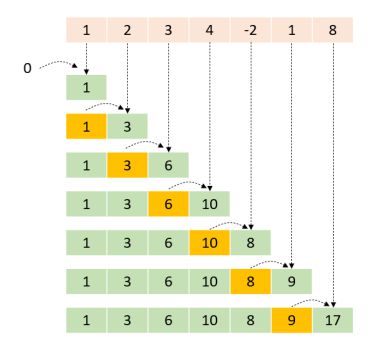
A parallel scan task performs the cumulative sum, also known as prefix sum or scan, of the input range and writes the result to the output range. Each element of the output range contains the running total of all earlier elements using the given binary operator for summation.
 [Image]
tf::cuda_inclusive_scan computes an inclusive prefix sum operation using the given binary operator over a range of elements specified by [first, last). The term "inclusive" means that the i-th input element is included in the i-th sum. The following code computes the inclusive prefix sum over an input array and stores the result in an output array.
const size_t N = 1000000;
int* input  = tf::cuda_malloc_shared<int>(N);  // input  vector
int* output = tf::cuda_malloc_shared<int>(N);  // output vector

// initializes the data
for(size_t i=0; i<N; input[i++] = rand());

// create an execution policy
tf::cudaStream stream;
tf::cudaDefaultExecutionPolicy policy(stream);

// queries the required buffer size to scan N elements using the given policy
auto bytes  = policy.scan_bufsz<int>(N);
auto buffer = tf::cuda_malloc_device<std::byte>(bytes);

// computes inclusive scan over input and stores the result in output
tf::cuda_inclusive_scan(policy,
  input, input + N, output, [] __device__ (int a, int b) {return a + b;}, buffer
);

// synchronizes and verifies the result
stream.synchronize();

for(size_t i=1; i<N; i++) {
  assert(output[i] == output[i-1] + input[i]);
}

// delete the device memory
cudaFree(input);
cudaFree(output);
cudaFree(buffer);
The scan algorithm runs asynchronously through the stream specified in the execution policy. You need to synchronize the stream to obtain correct results. Since the GPU scan algorithm may require extra buffer to store the temporary results, you need to provide a buffer of size at least larger or equal to the value returned from tf::cudaDefaultExecutionPolicy::scan_bufsz.
You must keep the buffer alive before the scan call completes.
On the other hand, tf::cuda_exclusive_scan computes an exclusive prefix sum operation. The term "exclusive" means that the i-th input element is NOT included in the i-th sum.
// computes exclusive scan over input and stores the result in output
tf::cuda_exclusive_scan(policy,
  input, input + N, output, [] __device__ (int a, int b) {return a + b;}, buffer
);

// synchronizes the execution and verifies the result
stream.synchronize();
for(size_t i=1; i<N; i++) {
  assert(output[i] == output[i-1] + input[i-1]);
}
tf::cuda_transform_inclusive_scan transforms each item in the range [first, last) and computes an inclusive prefix sum over these transformed items. The following code multiplies each item by 10 and then compute the inclusive prefix sum over 1000000 transformed items.
const size_t N = 1000000;
int* input  = tf::cuda_malloc_shared<int>(N);  // input  vector
int* output = tf::cuda_malloc_shared<int>(N);  // output vector

// initializes the data
for(size_t i=0; i<N; input[i++] = rand());

// create an execution policy
tf::cudaStream stream;
tf::cudaDefaultExecutionPolicy policy(stream);

// queries the required buffer size to scan N elements using the given policy
auto bytes  = policy.scan_bufsz<int>(N);
auto buffer = tf::cuda_malloc_device<std::byte>(bytes);

// computes inclusive scan over transformed input and stores the result in output
tf::cuda_transform_inclusive_scan(policy,
  input, input + N, output,
  [] __device__ (int a, int b) { return a + b; },  // binary scan operator
  [] __device__ (int a) { return a*10; },          // unary transform operator
  buffer
);

// wait for the scan to complete
stream.synchronize();

// verifies the result
for(size_t i=1; i<N; i++) {
  assert(output[i] == output[i-1] + input[i] * 10);
}

// delete the device memory
cudaFree(input);
cudaFree(output);
cudaFree(buffer);
Similarly, tf::cuda_transform_exclusive_scan performs an exclusive prefix sum over a range of transformed items. The following code computes the exclusive prefix sum over 1000000 transformed items each multiplied by 10.
const size_t N = 1000000;
int* input  = tf::cuda_malloc_shared<int>(N);  // input  vector
int* output = tf::cuda_malloc_shared<int>(N);  // output vector

// initializes the data
for(size_t i=0; i<N; input[i++] = rand());

// create an execution policy
tf::cudaStream stream;
tf::cudaDefaultExecutionPolicy policy(stream);

// queries the required buffer size to scan N elements using the given policy
auto bytes  = policy.scan_bufsz<int>(N);
auto buffer = tf::cuda_malloc_device<std::byte>(bytes);

// computes exclusive scan over transformed input and stores the result in output
tf::cuda_transform_exclusive_scan(policy,
  input, input + N, output,
  [] __device__ (int a, int b) { return a + b; },  // binary scan operator
  [] __device__ (int a) { return a*10; },          // unary transform operator
  buffer
);

// wait for the scan to complete
stream.synchronize();

// verifies the result
for(size_t i=1; i<N; i++) {
  assert(output[i] == output[i-1] + input[i-1] * 10);
}

// delete the device memory
cudaFree(input);
cudaFree(output);
cudaFree(buffer);
Search for symbols, directories, files, pages or
modules. You can omit any prefix from the symbol or file path; adding a
: or / suffix lists all members of given symbol or
directory.
Use ↓ / ↑ to navigate through the list, Enter to go. Tab autocompletes common prefix, you can copy a link to the result using L while M produces a Markdown link.
Taskflow handbook is part of the Taskflow project, copyright Dr. Tsung-Wei Huang, 2018–2025.
Generated by Doxygen 1.12.0 and m.css.
| Web Proxy Viewer | New URL | Original Page |
![[]](https://raw.githubusercontent.com/ModuleWorks/taskflow/task_isolation/docs/taskflow_logo.png)
![[Image]](https://raw.githubusercontent.com/ModuleWorks/taskflow/task_isolation/docs/scan.png)