| [ Web Proxy ] |
| Viewing: https://www.mirror.co.uk/weather/uk-weather-yellow-heat-alerts-37527689 | [Back] [Original] |
The yellow heat health alerts are in place from 9am on Saturday until 9pm on Tuesday
Fresh heat alerts are set to be issued as the UK prepares for its fifth heatwave of the year, with sweltering temperatures expected to soar to 36C.
The yellow heat health alerts are in place from 9am on Saturday until 9pm on Tuesday, cautioning that the scorching conditions are likely to impact the wellbeing of the general public.
The Met Office has warned that temperatures will rise throughout the weekend as heatwave conditions make a return, with highs of 36C forecast for parts of East Anglia and south-east England by Thursday.
Forecasters have predicted a north-south weather divide over the weekend(Image: Gareth Fuller/PA Wire)
Two record-breaking heatwaves, in May and June, resulted in more than 2,800 excess deaths, while two further heatwaves in July have fuelled drought and wildfires across the country.
The peak temperature recorded this year was 38C, measured at Lingwood in Norfolk on June 28.
A total of 33 days this year have already seen temperatures surpass 30C somewhere across the UK. The all-time record of 34 days set back in 1995 looks set to be broken as early as next week.
Forecasters have predicted a north-south weather divide over the weekend, with Scotland and Northern Ireland likely to experience heavy downpours, while England and Wales will remain largely dry, sunny and increasingly warm.
Temperatures could hit 30C on Saturday, before climbing into the low 30s across southern and south-east England on Sunday.
 [The scene of devastation follwing the recent wildfire which spread out over the Sychnant Pass in Wales.]
The scene of devastation follwing the recent wildfire which spread out over the Sychnant Pass in Wales.(Image: Patrick O'Neill / SWNS)
Highs of up to 30C are possible across parts of England and Wales on Tuesday, rising to between 32C and 34C on Wednesday, with the hottest conditions currently expected on Thursday. The UK Health Security Agency (UKHSA) has issued yellow heat health alerts for the East Midlands, West Midlands, South East, South West, East of England, Yorkshire and the Humber and London.
Meanwhile, the National Trust is urging people to sign a petition calling on the Government to make tackling climate change a national mission.
It follows a series of wildfires that have broken out across the UK in recent weeks, with major blazes at Dunwich Heath in Suffolk, Headon Warren on the Isle of Wight, Llanwonno in the Rhondda Valleys, South Wales, and the Cairngorms National Park in Scotland.
Fires are likely to become exceptionally severe on Sunday for almost all of the east and south-east of England, according to the Fire Severity Index. "Exceptional" severity is its highest ranking.
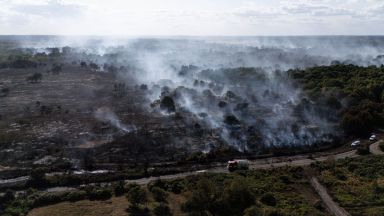 [Smoke rises from the smouldering remains of a wildfire at Dunwich Heath, near Leiston, ]
Smoke rises from the smouldering remains of a wildfire at Dunwich Heath, near Leiston(Image: Jacob King/PA Wire)
Met Office data, which takes into account rainfall, temperature and humidity, is used by agencies to gauge how severe a fire could become if one breaks out. It does not, however, cover the likelihood of wildfires occurring.
Reservoir storage in England has dropped to 69%, down from 72% a week ago and nearly 12 percentage points below the long-term average for this time of year, the Environment Agency confirmed on Friday.
Storage stood at 85% at the end of June, which was the average for that point in the year, but has fallen steadily over recent weeks. Five reservoirs are now classified as having "exceptionally low" levels: Blagdon in Somerset (54% full); Clywedog in Powys, which supplies water for central and north-west England (62%); the Dove group of reservoirs in Derbyshire (74%); Hanningfield in Essex (60%); and Wimbleball in Somerset (50%).
Last month was the driest July for England and Wales since records began in 1836, according to provisional figures released by the Met Office.
Nineteen counties across England recorded effectively no rainfall 1mm or less throughout the entire month, Met Office figures show.
Choose Daily Mirror as a 'Preferred Source' on Google News for quick access to the news you value.
 [Google Preferred Source Badge]
At Reach and across our entities we and our partners use information collected through cookies and other identifiers from your device to improve experience on our site, analyse how it is used and to show personalised advertising. You can opt out of the sale or sharing of your data, at any time clicking the "Do Not Sell or Share my Data" button at the bottom of the webpage. Please note that your preferences are browser specific. Use of our website and any of our services represents your acceptance of the use of cookies and consent to the practices described in our Privacy Notice and Terms and Conditions.
Accept| Web Proxy Viewer | New URL | Original Page |


![[Daily Mirror]](https://www.mirror.co.uk/nav-web-static/main-1203a175ed6ce47e924c82721a3f0ba020eab5f8/public/assets/mirror/logos/masthead-mirror-default.svg)
![[United Kingdom]](https://www.mirror.co.uk/images/icons/flags/united_kingdom.svg)
![[USA]](https://www.mirror.co.uk/images/icons/flags/usa.svg)
![[Republic of Ireland]](https://www.mirror.co.uk/images/icons/flags/republic_of_ireland.svg)
![[Daily Mirror Icon]](https://www.mirror.co.uk/assets/icons/mirror.svg)
![[The yellow heat health alerts are in place from 9am on Saturday until 9pm on Tuesday]](https://i2-prod.mirror.co.uk/article37361727.ece/ALTERNATES/s1200f/3_GettyImages-2282584751.jpg)
![[Forecasters have predicted a north-south weather divide over the weekend]](https://i2-prod.mirror.co.uk/article37527695.ece/ALTERNATES/s1200e/0_Summer-weather-Aug-4th-2026.jpg)
![[The scene of devastation follwing the recent wildfire which spread out over the Sychnant Pass in Wales.]](https://i2-prod.mirror.co.uk/article37527696.ece/ALTERNATES/s1200e/0_Wildfire-damage-from-the-Sychnant-Pass-wildfire-in-Wales.jpg)
![[Smoke rises from the smouldering remains of a wildfire at Dunwich Heath, near Leiston, ]](https://i2-prod.mirror.co.uk/article37527703.ece/ALTERNATES/s1200e/0_Suffolk-coast-wildfire.jpg)
![[Google Preferred Source Badge]](https://www.mirror.co.uk/_next/image?url=%2Fgoogle-preferred-source-badge-dark.png&w=640&q=75)
![[Ipso logo]](https://www.mirror.co.uk/footer/ipso.svg)
![[trust project logo]](https://www.mirror.co.uk/footer/trust-project.svg)
![[reach logo]](https://www.mirror.co.uk/_next/image?url=%2Fnav-web-static%2Fmain-1203a175ed6ce47e924c82721a3f0ba020eab5f8%2F_next%2Fstatic%2Fmedia%2Flogo-reach.18f672b1.png&w=384&q=75)