Commit f5477e3
committed
docs: split the long ML tutorial pages into one page per example
For nn, gann, kerasga, and torchga, keep the module reference (intro, classes,
functions, and steps) on the main page and move each worked example to its own
page, linked from an Examples card grid and a nested toctree. cnn and gacnn
(single example each) are unchanged. No internal links break: example sections
are not referenced, and cnn.html#reading-the-data stays on the cnn page.1 parent 6959c25 commit f5477e3
21 files changed
Lines changed: 2393 additions & 2273 deletions
File tree
- docs/source
Large diffs are not rendered by default.
| Original file line number | Diff line number | Diff line change | |
|---|---|---|---|
@@ -0,0 +1,146 @@ | |||
| 1 | + # Image Classification | ||
| 2 | + | ||
| 3 | + In the documentation of the `pygad.nn` module, a neural network is created for classifying images from the Fruits360 dataset without being trained using an optimization algorithm. This section discusses how to train such a classifier using the genetic algorithm with the help of the `pygad.gann` module. | ||
| 4 | + | ||
| 5 | + Please make sure that the training data files [dataset_features.npy](https://github.com/ahmedfgad/NumPyANN/blob/master/dataset_features.npy) and [outputs.npy](https://github.com/ahmedfgad/NumPyANN/blob/master/outputs.npy) are available. For downloading them, use these links: | ||
| 6 | + | ||
| 7 | + 1. [dataset_features.npy](https://github.com/ahmedfgad/NumPyANN/blob/master/dataset_features.npy): The features https://github.com/ahmedfgad/NumPyANN/blob/master/dataset_features.npy | ||
| 8 | + 2. [outputs.npy](https://github.com/ahmedfgad/NumPyANN/blob/master/outputs.npy): The class labels https://github.com/ahmedfgad/NumPyANN/blob/master/outputs.npy | ||
| 9 | + | ||
| 10 | + After the data is available, here is the complete code that builds and trains a neural network using the genetic algorithm for classifying images from 4 classes of the Fruits360 dataset. | ||
| 11 | + | ||
| 12 | + Because there are 4 classes, the output layer is assigned has 4 neurons according to the `num_neurons_output` parameter of the `pygad.gann.GANN` class constructor. | ||
| 13 | + | ||
| 14 | + ```python | ||
| 15 | + import numpy | ||
| 16 | + import pygad | ||
| 17 | + import pygad.nn | ||
| 18 | + import pygad.gann | ||
| 19 | + | ||
| 20 | + def fitness_func(ga_instance, solution, sol_idx): | ||
| 21 | + global GANN_instance, data_inputs, data_outputs | ||
| 22 | + | ||
| 23 | + predictions = pygad.nn.predict(last_layer=GANN_instance.population_networks[sol_idx], | ||
| 24 | + data_inputs=data_inputs) | ||
| 25 | + correct_predictions = numpy.where(predictions == data_outputs)[0].size | ||
| 26 | + solution_fitness = (correct_predictions/data_outputs.size)*100 | ||
| 27 | + | ||
| 28 | + return solution_fitness | ||
| 29 | + | ||
| 30 | + def callback_generation(ga_instance): | ||
| 31 | + global GANN_instance, last_fitness | ||
| 32 | + | ||
| 33 | + population_matrices = pygad.gann.population_as_matrices(population_networks=GANN_instance.population_networks, | ||
| 34 | + population_vectors=ga_instance.population) | ||
| 35 | + | ||
| 36 | + GANN_instance.update_population_trained_weights(population_trained_weights=population_matrices) | ||
| 37 | + | ||
| 38 | + print(f"Generation = {ga_instance.generations_completed}") | ||
| 39 | + print(f"Fitness = {ga_instance.best_solution()[1]}") | ||
| 40 | + print(f"Change = {ga_instance.best_solution()[1] - last_fitness}") | ||
| 41 | + | ||
| 42 | + last_fitness = ga_instance.best_solution()[1].copy() | ||
| 43 | + | ||
| 44 | + # Holds the fitness value of the previous generation. | ||
| 45 | + last_fitness = 0 | ||
| 46 | + | ||
| 47 | + # Reading the input data. | ||
| 48 | + data_inputs = numpy.load("dataset_features.npy") # Download from https://github.com/ahmedfgad/NumPyANN/blob/master/dataset_features.npy | ||
| 49 | + | ||
| 50 | + # Optional step of filtering the input data using the standard deviation. | ||
| 51 | + features_STDs = numpy.std(a=data_inputs, axis=0) | ||
| 52 | + data_inputs = data_inputs[:, features_STDs>50] | ||
| 53 | + | ||
| 54 | + # Reading the output data. | ||
| 55 | + data_outputs = numpy.load("outputs.npy") # Download from https://github.com/ahmedfgad/NumPyANN/blob/master/outputs.npy | ||
| 56 | + | ||
| 57 | + # The length of the input vector for each sample (i.e. number of neurons in the input layer). | ||
| 58 | + num_inputs = data_inputs.shape[1] | ||
| 59 | + # The number of neurons in the output layer (i.e. number of classes). | ||
| 60 | + num_classes = 4 | ||
| 61 | + | ||
| 62 | + # Creating an initial population of neural networks. The return of the initial_population() function holds references to the networks, not their weights. Using such references, the weights of all networks can be fetched. | ||
| 63 | + num_solutions = 8 # A solution or a network can be used interchangeably. | ||
| 64 | + GANN_instance = pygad.gann.GANN(num_solutions=num_solutions, | ||
| 65 | + num_neurons_input=num_inputs, | ||
| 66 | + num_neurons_hidden_layers=[150, 50], | ||
| 67 | + num_neurons_output=num_classes, | ||
| 68 | + hidden_activations=["relu", "relu"], | ||
| 69 | + output_activation="softmax") | ||
| 70 | + | ||
| 71 | + # population does not hold the numerical weights of the network instead it holds a list of references to each last layer of each network (i.e. solution) in the population. A solution or a network can be used interchangeably. | ||
| 72 | + # If there is a population with 3 solutions (i.e. networks), then the population is a list with 3 elements. Each element is a reference to the last layer of each network. Using such a reference, all details of the network can be accessed. | ||
| 73 | + population_vectors = pygad.gann.population_as_vectors(population_networks=GANN_instance.population_networks) | ||
| 74 | + | ||
| 75 | + # To prepare the initial population, there are 2 ways: | ||
| 76 | + # 1) Prepare it yourself and pass it to the initial_population parameter. This way is useful when the user wants to start the genetic algorithm with a custom initial population. | ||
| 77 | + # 2) Assign valid integer values to the sol_per_pop and num_genes parameters. If the initial_population parameter exists, then the sol_per_pop and num_genes parameters are useless. | ||
| 78 | + initial_population = population_vectors.copy() | ||
| 79 | + | ||
| 80 | + num_parents_mating = 4 # Number of solutions to be selected as parents in the mating pool. | ||
| 81 | + | ||
| 82 | + num_generations = 500 # Number of generations. | ||
| 83 | + | ||
| 84 | + mutation_percent_genes = 10 # Percentage of genes to mutate. This parameter has no action if the parameter mutation_num_genes exists. | ||
| 85 | + | ||
| 86 | + parent_selection_type = "sss" # Type of parent selection. | ||
| 87 | + | ||
| 88 | + crossover_type = "single_point" # Type of the crossover operator. | ||
| 89 | + | ||
| 90 | + mutation_type = "random" # Type of the mutation operator. | ||
| 91 | + | ||
| 92 | + keep_parents = -1 # Number of parents to keep in the next population. -1 means keep all parents and 0 means keep nothing. | ||
| 93 | + | ||
| 94 | + ga_instance = pygad.GA(num_generations=num_generations, | ||
| 95 | + num_parents_mating=num_parents_mating, | ||
| 96 | + initial_population=initial_population, | ||
| 97 | + fitness_func=fitness_func, | ||
| 98 | + mutation_percent_genes=mutation_percent_genes, | ||
| 99 | + parent_selection_type=parent_selection_type, | ||
| 100 | + crossover_type=crossover_type, | ||
| 101 | + mutation_type=mutation_type, | ||
| 102 | + keep_parents=keep_parents, | ||
| 103 | + on_generation=callback_generation) | ||
| 104 | + | ||
| 105 | + ga_instance.run() | ||
| 106 | + | ||
| 107 | + # After the generations complete, a plot is shown that summarizes how the fitness values evolve over the generations. | ||
| 108 | + ga_instance.plot_fitness() | ||
| 109 | + | ||
| 110 | + # Returning the details of the best solution. | ||
| 111 | + solution, solution_fitness, solution_idx = ga_instance.best_solution() | ||
| 112 | + print(f"Parameters of the best solution : {solution}") | ||
| 113 | + print(f"Fitness value of the best solution = {solution_fitness}") | ||
| 114 | + print(f"Index of the best solution : {solution_idx}") | ||
| 115 | + | ||
| 116 | + if ga_instance.best_solution_generation != -1: | ||
| 117 | + print(f"Best fitness value reached after {ga_instance.best_solution_generation} generations.") | ||
| 118 | + | ||
| 119 | + # Predicting the outputs of the data using the best solution. | ||
| 120 | + predictions = pygad.nn.predict(last_layer=GANN_instance.population_networks[solution_idx], | ||
| 121 | + data_inputs=data_inputs) | ||
| 122 | + print(f"Predictions of the trained network : {predictions}") | ||
| 123 | + | ||
| 124 | + # Calculating some statistics | ||
| 125 | + num_wrong = numpy.where(predictions != data_outputs)[0] | ||
| 126 | + num_correct = data_outputs.size - num_wrong.size | ||
| 127 | + accuracy = 100 * (num_correct/data_outputs.size) | ||
| 128 | + print(f"Number of correct classifications : {num_correct}.") | ||
| 129 | + print(f"Number of wrong classifications : {num_wrong.size}.") | ||
| 130 | + print(f"Classification accuracy : {accuracy}.") | ||
| 131 | + ``` | ||
| 132 | + | ||
| 133 | + After training completes, here are the outputs of the print statements. The number of wrong classifications is only 1 and the accuracy is 99.949%. This accuracy is reached after 482 generations. | ||
| 134 | + | ||
| 135 | + ``` | ||
| 136 | + Fitness value of the best solution = 99.94903160040775 | ||
| 137 | + Index of the best solution : 0 | ||
| 138 | + Best fitness value reached after 482 generations. | ||
| 139 | + Number of correct classifications : 1961. | ||
| 140 | + Number of wrong classifications : 1. | ||
| 141 | + Classification accuracy : 99.94903160040775. | ||
| 142 | + ``` | ||
| 143 | + | ||
| 144 | + The next figure shows how fitness value evolves by generation. | ||
| 145 | + | ||
| 146 | + 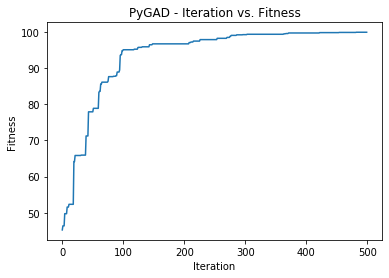 | ||
| Original file line number | Diff line number | Diff line change | |
|---|---|---|---|
@@ -0,0 +1,153 @@ | |||
| 1 | + # Regression Example 1 | ||
| 2 | + | ||
| 3 | + To train a neural network for regression, follow these instructions: | ||
| 4 | + | ||
| 5 | + 1. Set the `output_activation` parameter in the constructor of the `pygad.gann.GANN` class to `"None"`. It is possible to use the ReLU function if all outputs are nonnegative. | ||
| 6 | + | ||
| 7 | + ```python | ||
| 8 | + GANN_instance = pygad.gann.GANN(... | ||
| 9 | + output_activation="None") | ||
| 10 | + ``` | ||
| 11 | + | ||
| 12 | + 2. Wherever the `pygad.nn.predict()` function is used, set the `problem_type` parameter to `"regression"`. | ||
| 13 | + | ||
| 14 | + ```python | ||
| 15 | + predictions = pygad.nn.predict(..., | ||
| 16 | + problem_type="regression") | ||
| 17 | + ``` | ||
| 18 | + | ||
| 19 | + 3. Design the fitness function to calculate the error (e.g. mean absolute error). | ||
| 20 | + | ||
| 21 | + ```python | ||
| 22 | + def fitness_func(ga_instance, solution, sol_idx): | ||
| 23 | + ... | ||
| 24 | + | ||
| 25 | + predictions = pygad.nn.predict(..., | ||
| 26 | + problem_type="regression") | ||
| 27 | + | ||
| 28 | + solution_fitness = 1.0/numpy.mean(numpy.abs(predictions - data_outputs)) | ||
| 29 | + | ||
| 30 | + return solution_fitness | ||
| 31 | + ``` | ||
| 32 | + | ||
| 33 | + The next code builds a complete example for building a neural network for regression. | ||
| 34 | + | ||
| 35 | + ```python | ||
| 36 | + import numpy | ||
| 37 | + import pygad | ||
| 38 | + import pygad.nn | ||
| 39 | + import pygad.gann | ||
| 40 | + | ||
| 41 | + def fitness_func(ga_instance, solution, sol_idx): | ||
| 42 | + global GANN_instance, data_inputs, data_outputs | ||
| 43 | + | ||
| 44 | + predictions = pygad.nn.predict(last_layer=GANN_instance.population_networks[sol_idx], | ||
| 45 | + data_inputs=data_inputs, problem_type="regression") | ||
| 46 | + solution_fitness = 1.0/numpy.mean(numpy.abs(predictions - data_outputs)) | ||
| 47 | + | ||
| 48 | + return solution_fitness | ||
| 49 | + | ||
| 50 | + def callback_generation(ga_instance): | ||
| 51 | + global GANN_instance, last_fitness | ||
| 52 | + | ||
| 53 | + population_matrices = pygad.gann.population_as_matrices(population_networks=GANN_instance.population_networks, | ||
| 54 | + population_vectors=ga_instance.population) | ||
| 55 | + | ||
| 56 | + GANN_instance.update_population_trained_weights(population_trained_weights=population_matrices) | ||
| 57 | + | ||
| 58 | + print(f"Generation = {ga_instance.generations_completed}") | ||
| 59 | + print(f"Fitness = {ga_instance.best_solution(pop_fitness=ga_instance.last_generation_fitness)[1]}") | ||
| 60 | + print(f"Change = {ga_instance.best_solution(pop_fitness=ga_instance.last_generation_fitness)[1] - last_fitness}") | ||
| 61 | + | ||
| 62 | + last_fitness = ga_instance.best_solution(pop_fitness=ga_instance.last_generation_fitness)[1].copy() | ||
| 63 | + | ||
| 64 | + # Holds the fitness value of the previous generation. | ||
| 65 | + last_fitness = 0 | ||
| 66 | + | ||
| 67 | + # Preparing the NumPy array of the inputs. | ||
| 68 | + data_inputs = numpy.array([[2, 5, -3, 0.1], | ||
| 69 | + [8, 15, 20, 13]]) | ||
| 70 | + | ||
| 71 | + # Preparing the NumPy array of the outputs. | ||
| 72 | + data_outputs = numpy.array([[0.1, 0.2], | ||
| 73 | + [1.8, 1.5]]) | ||
| 74 | + | ||
| 75 | + # The length of the input vector for each sample (i.e. number of neurons in the input layer). | ||
| 76 | + num_inputs = data_inputs.shape[1] | ||
| 77 | + | ||
| 78 | + # Creating an initial population of neural networks. The return of the initial_population() function holds references to the networks, not their weights. Using such references, the weights of all networks can be fetched. | ||
| 79 | + num_solutions = 6 # A solution or a network can be used interchangeably. | ||
| 80 | + GANN_instance = pygad.gann.GANN(num_solutions=num_solutions, | ||
| 81 | + num_neurons_input=num_inputs, | ||
| 82 | + num_neurons_hidden_layers=[2], | ||
| 83 | + num_neurons_output=2, | ||
| 84 | + hidden_activations=["relu"], | ||
| 85 | + output_activation="None") | ||
| 86 | + | ||
| 87 | + # population does not hold the numerical weights of the network instead it holds a list of references to each last layer of each network (i.e. solution) in the population. A solution or a network can be used interchangeably. | ||
| 88 | + # If there is a population with 3 solutions (i.e. networks), then the population is a list with 3 elements. Each element is a reference to the last layer of each network. Using such a reference, all details of the network can be accessed. | ||
| 89 | + population_vectors = pygad.gann.population_as_vectors(population_networks=GANN_instance.population_networks) | ||
| 90 | + | ||
| 91 | + # To prepare the initial population, there are 2 ways: | ||
| 92 | + # 1) Prepare it yourself and pass it to the initial_population parameter. This way is useful when the user wants to start the genetic algorithm with a custom initial population. | ||
| 93 | + # 2) Assign valid integer values to the sol_per_pop and num_genes parameters. If the initial_population parameter exists, then the sol_per_pop and num_genes parameters are useless. | ||
| 94 | + initial_population = population_vectors.copy() | ||
| 95 | + | ||
| 96 | + num_parents_mating = 4 # Number of solutions to be selected as parents in the mating pool. | ||
| 97 | + | ||
| 98 | + num_generations = 500 # Number of generations. | ||
| 99 | + | ||
| 100 | + mutation_percent_genes = 5 # Percentage of genes to mutate. This parameter has no action if the parameter mutation_num_genes exists. | ||
| 101 | + | ||
| 102 | + parent_selection_type = "sss" # Type of parent selection. | ||
| 103 | + | ||
| 104 | + crossover_type = "single_point" # Type of the crossover operator. | ||
| 105 | + | ||
| 106 | + mutation_type = "random" # Type of the mutation operator. | ||
| 107 | + | ||
| 108 | + keep_parents = 1 # Number of parents to keep in the next population. -1 means keep all parents and 0 means keep nothing. | ||
| 109 | + | ||
| 110 | + init_range_low = -1 | ||
| 111 | + init_range_high = 1 | ||
| 112 | + | ||
| 113 | + ga_instance = pygad.GA(num_generations=num_generations, | ||
| 114 | + num_parents_mating=num_parents_mating, | ||
| 115 | + initial_population=initial_population, | ||
| 116 | + fitness_func=fitness_func, | ||
| 117 | + mutation_percent_genes=mutation_percent_genes, | ||
| 118 | + init_range_low=init_range_low, | ||
| 119 | + init_range_high=init_range_high, | ||
| 120 | + parent_selection_type=parent_selection_type, | ||
| 121 | + crossover_type=crossover_type, | ||
| 122 | + mutation_type=mutation_type, | ||
| 123 | + keep_parents=keep_parents, | ||
| 124 | + on_generation=callback_generation) | ||
| 125 | + | ||
| 126 | + ga_instance.run() | ||
| 127 | + | ||
| 128 | + # After the generations complete, a plot is shown that summarizes how the fitness values evolve over the generations. | ||
| 129 | + ga_instance.plot_fitness() | ||
| 130 | + | ||
| 131 | + # Returning the details of the best solution. | ||
| 132 | + solution, solution_fitness, solution_idx = ga_instance.best_solution(pop_fitness=ga_instance.last_generation_fitness) | ||
| 133 | + print(f"Parameters of the best solution : {solution}") | ||
| 134 | + print(f"Fitness value of the best solution = {solution_fitness}") | ||
| 135 | + print(f"Index of the best solution : {solution_idx}") | ||
| 136 | + | ||
| 137 | + if ga_instance.best_solution_generation != -1: | ||
| 138 | + print(f"Best fitness value reached after {ga_instance.best_solution_generation} generations.") | ||
| 139 | + | ||
| 140 | + # Predicting the outputs of the data using the best solution. | ||
| 141 | + predictions = pygad.nn.predict(last_layer=GANN_instance.population_networks[solution_idx], | ||
| 142 | + data_inputs=data_inputs, | ||
| 143 | + problem_type="regression") | ||
| 144 | + print(f"Predictions of the trained network : {predictions}") | ||
| 145 | + | ||
| 146 | + # Calculating some statistics | ||
| 147 | + abs_error = numpy.mean(numpy.abs(predictions - data_outputs)) | ||
| 148 | + print(f"Absolute error : {abs_error}.") | ||
| 149 | + ``` | ||
| 150 | + | ||
| 151 | + The next figure shows how the fitness value changes for the generations used. | ||
| 152 | + | ||
| 153 | + 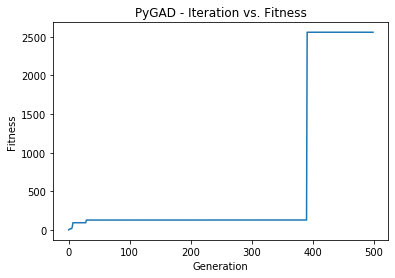 | ||
0 commit comments