Commit 3507c99
| Original file line number | Diff line number | Diff line change | |
|---|---|---|---|
@@ -138,12 +138,12 @@ Suggestions and improvements are very welcome! | |||
| 138 | 138 | ||
| 139 | 139 | Here is containment `C[i, j]` for a range of chunk sizes from 1 to 12 for computing `groupby("time.month")` of a monthly mean dataset. | |
| 140 | 140 | The images only show 12 time steps. | |
| 141 | - These are colored so that light yellow is C=0, and dark purple is C=1. | ||
| 141 | + These are colored so that light yellow is `C=0`, and dark purple is `C=1`. | ||
| 142 | 142 | `C[i,j] = 1` when the chunks occupied by group `i` perfectly overlaps with those occupied by group `j` (so the diagonal elements | |
| 143 | 143 | are always 1). | |
| 144 | 144 | The title on each image is `(chunk size, sparsity)`. | |
| 145 | - When the chunksize _is_ a divisor of the period 12, $C$ is a [block diagonal](https://en.wikipedia.org/wiki/Block_matrix) matrix. | ||
| 146 | - When the chunksize _is not_ a divisor of the period 12, $C$ is much less sparse in comparison. | ||
| 145 | + When the chunksize _is_ a divisor of the period 12, `C` is a [block diagonal](https://en.wikipedia.org/wiki/Block_matrix) matrix. | ||
| 146 | + When the chunksize _is not_ a divisor of the period 12, `C` is much less sparse in comparison. | ||
| 147 | 147 | 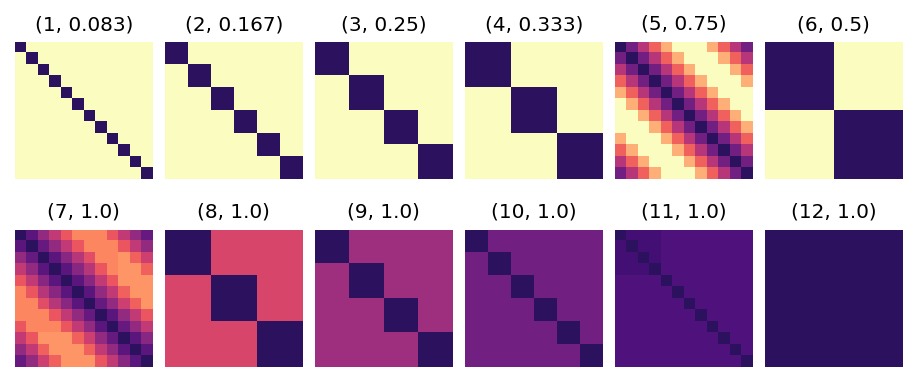 | |
| 148 | 148 | ||
| 149 | 149 | Given the above `C`, flox will choose `"cohorts"` for chunk sizes (1, 2, 3, 4, 6, 12), and `"map-reduce"` for the rest. | |
0 commit comments