| [ Web Proxy ] |
| Viewing: https://www.dailystar.co.uk/news/world-news/tsunami-waves-hit-fukushima-nuclear-35642058 | [Back] [Original] |
The Fukushima Dai-ichi Nuclear Power plant on March 14, 2011(Image: DigitalGlobe via Getty Images)
A massive 8.8 magnitude earthquake has struck off the coast of eastern Russia leading to a series of tsunami warnings around the world. Most worryingly a tsunami warning has been issued for Japan's Fukushima nuclear power plant, which has been evacuated.
The panic started after devastating four metre high tsunami waves led to buildings damaged and severe flooding in the city of Petropavlovsk-Kamchatsky on Russia's Kamchatka Peninsula. The shallow earthquake has caused injuries for several people while on Japan's eastern coast an order was made to evacuate. A nursery was damaged but most buildings were able to stand firm, said authorities in Russia.
"Today's earthquake was serious and the strongest in decades of tremors," Kamchatka Governor Vladimir Solodov said in a video posted on the Telegram messaging app. Russian scientists said it was the most powerful quake to hit the region since 1952. It has been recorded as the sixth-largest earthquake on record.
Tsunami warning map after an earthquake in Russia (Image: Getty/AP)
The Kamchatka Peninsula region has declared a state of emergency, according to state media TASS, citing authorities. Videos show water rushing between buildings, damaging industrial infrastructure and sweeping away large debris.
Sakhalin Governor Valery Limarenko said: "Residents of the settlement remain safe on higher ground until the threat of additional waves is fully lifted."
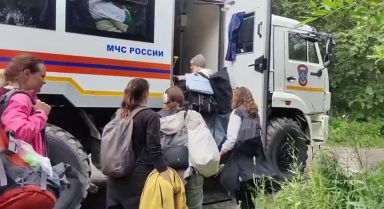
Rescuers evacuate people in Russia's Kamchatka region (Image: RUSSIAN MINISTRY OF EMERGENCY SI)
Japans Meteorological Agency has confirmed tsunami waves have reached the coastlines of Fukushima, Miyagi, and Iwate prefectures. The highest wave is currently 1.3 metres, with the highest potentially reaching 3 metres, according to officials.
Although no major damage has been reported yet, the Fukushima power plant has been evacuated, along with thousands of other citizens along the coast.
We have evacuated all workers and employees from the Fukushima Daiichi plant, a spokesperson for the plant operator Tepco told AFP news agency, adding that no abnormality was observed at the site.
In 2011, following an earthquake a tsunami hit the Fukushima plant, leading to a partial meltdown of the reactor cores and the release of radioactive materials.
The unit 3 reactor at the Fukushima Daiichi nuclear power plant(Image: AP)
Japan's Fire and Disaster Management Agency said nearly two million residents are now under evacuation advisories in more than 220 municipalities along the Pacific coast.
It added that one person was slightly injured on the northern island of Hokkaido when a woman in her 60s fell while rushing to evacuate. She was taken to a hospital.
A two feet tsunami arrived at Hamanaka town on the northern Japanese island of Hokkaido and Kuji port in Iwate on the main island, up from the earlier tsunami of 40 centimetres (1.3 ft), according to the JMA. A tsunami of 20 cm (7.9 inches) was detected in the Tokyo Bay, according to the Japan Meteorological Agency.
Shiji Kiyomoto, a JMA earthquake and tsunami response official, said second or third tsunami waves of tsunami had arrived. Kiyomoto did not say when tsunami alerts would be lifted, and said high waves may last for at least a day, urging residents to stay at safe places.
The first waves triggered by the huge earthquake off Russias coast have reached Hawaii, with a 4ft (1.2 metre) wave recorded off Oahu.
Hawaii Gov Josh Green said data from Midway Atoll, which is part of the way between Japan and Hawaii, measured tsunami waves from peak to trough of 6 feet (1.8 metres).
He said waves hitting Hawaii could be bigger or smaller and it was too early to tell how large they would be. A tsunami of that size would be akin to a three feet wave riding on top of surf, he said. He told a new conference that a wave that size could move cars and throw fences around.
A giant earthquake has hit eastern Russia, causing global repercussions(Image: Cautious News/e2w news)
"It can dislodge trees, that's why you can't just be out there. The impact is at great speed," Gov Green said. "Any any structure that gets loose and strikes the individual could take them out. And people can drown quite easily with the force of that kind of wave."
Gov Green said Black Hawk helicopters have been activated and high-water vehicles were ready to go in case authorities need to rescue people. "But please do not put yourself in harm's way," he said.
The small Northern California community of Crescent City turned on its tsunami sirens to warn residents about possible waves. Last night seismologist Dr. Lucy Jones said the waves would be expected at "1am [today, July 30], which coincidentally is high tide".
"You are hearing a Tsunami Siren. We are under a Tsunami Warning. Please stay away from beaches and waterways. A predicted wave may hit at 11:55 pm. We are waiting on additional information about any level of evacuation," read a post from the City Hall Facebook account.
Ocean Beach in San Francisco, California, yesterday (July 29)(Image: AP)
The city in rural Northern California has roughly 6,000 residents. A tsunami in 1964 caused by an earthquake in Alaska caused a wave 21 feet (6.4 meters) high to hit the city, killing 11 people and destroying its downtown.
"This will NOT be a single wave. Do NOT try to go to the coast to take photos," the National Weather Service San Francisco Bay Area office posted on X.
The agency warned people could put themselves and any rescue teams that may be out at risk. The Bay Area is under a tsunami advisory. Communities further north are under a warning.
A tsunami of less than 30 centimetres (under 1 foot) was forecast to hit parts of Vancouver Island in western Canada. It is unknown exactly when this will hit.
The British Columbia provincial emergency preparedness agency said "multiple waves over time" were expected on the British Colombia coast. The agency said local governments should consider evacuating marinas, beaches and other areas near the ocean.
China's Ministry of Natural Resources' Tsunami Warning Center initially issued an alert for parts of the country's east coast along Shanghai and Zhejiang provinces, although that has now been cancelled.
The warning had forecasted that waves could reach between 0.3 to 1 metre. Shanghai and Zhejiang are already under alert as Typhoon CoMay is expected to land in the Zhejiang province Wednesday.
Pictures of the aftermath in Severo-Kurilsk, Russia, where tsunami flooding has caused major damage(Image: TASS)
Mexico's Navy says waves between 30 to 100 centimetres (1 to 3.3 feet) are expected on the Mexican Pacific coast after the tsunami set off by the 8.8-magnitude earthquake in Russia's Far East.
In a report, the Navy's tsunami warning centre said the waves will begin to reach the northern coast in Ensenada, near California, at around 2.22am Wednesday central time in Mexico, and it will continue south along the Pacific coast until it reaches the Chiapas states around 7.15am local time.
The Pacific coast remains under a tsunami advisory, and the Navy recommended people stay away from the beaches until it suspends an alert.
New Zealand's National Emergency Management Agency (NEMA) had initially said there was no tsunami threat, but has now reassessed after the earthquake's magnitude was upgraded.
Authorities issued warnings of "strong and unusual currents and unpredictable surges" along all coastlines of the South Pacific island nation. Waves were not expected to arrive until late Wednesday night local time, officials said.
The alert sent to New Zealanders' phones by the government emergency management agency said people should move out of the water, off beaches and shore areas and away from harbours, marinas, rivers and estuaries, but officials stopped short of issuing evacuation warnings.
NEMA said: "Strong and unusual currents and unpredictable surges will continue for several hours and the threat must be regarded as real until this advisory is cancelled."
A traffic jam forms in Honolulu, Hawaii, Tuesday, July 29, 2025 as people heed a tsunami evacuation warning(Image: AP)
Authorities in a number of small island nations in the South Pacific Ocean urged people to stay away from coastlines, familiarize themselves with evacuation routes and await further guidance from officials, but did not order evacuations.
Some tiny and low-lying Pacific island chains are among the world's most imperiled by tsunamis and rising seas. Cautions to stay away from beaches until any wave surges passed late Wednesday were issued by officials in Fiji, Samoa, Tonga, Federated States of Micronesia and Solomon Islands.
For the latest breaking news and stories from across the globe from the Daily Star, sign up for our newsletters.
Choose Daily Star as a 'Preferred Source' on Google News for quick access to the news you value.
 [Google Preferred Source Badge]
At Reach and across our entities we and our partners use information collected through cookies and other identifiers from your device to improve experience on our site, analyse how it is used and to show personalised advertising. You can opt out of the sale or sharing of your data, at any time clicking the "Do Not Sell or Share my Data" button at the bottom of the webpage. Please note that your preferences are browser specific. Use of our website and any of our services represents your acceptance of the use of cookies and consent to the practices described in our Privacy Notice and Terms and Conditions.
Accept| Web Proxy Viewer | New URL | Original Page |




![[Daily Star]](https://www.dailystar.co.uk/nav-web-static/main-1203a175ed6ce47e924c82721a3f0ba020eab5f8/public/assets/dailystar/logos/masthead-dailystar-default.svg)
![[Dailystar Icon]](https://www.dailystar.co.uk/assets/icons/daily-star.svg)
![[The Fukushima Dai-ichi Nuclear Power plant on March 14, 2011]](https://i2-prod.dailystar.co.uk/article35296658.ece/ALTERNATES/s1200f/0_Magnitude-89-Earthquake-And-Tsunami-Devastate-Northern-Japan.jpg)
![[Tsunami warning map after an earthquake in Russia ]](https://i2-prod.dailystar.co.uk/article35642133.ece/ALTERNATES/s1200e/0_GettyImages-1309699224_MAP.jpg)
![[ rescuers evacuating people in Russia's Kamchatka region ]](https://i2-prod.dailystar.co.uk/article35642410.ece/ALTERNATES/s1200e/0_RUSSIA-QUAKE-TSUNAMI.jpg)
![[The unit 3 reactor at the Fukushima Daiichi nuclear power plant]](https://i2-prod.dailystar.co.uk/article35642105.ece/ALTERNATES/s1200e/0_Japan-Nuclear-Fukushima-25210310971736.jpg)
![[A giant earthquake and tsunami hits eastern Russia - the image shows falling debris on the Kuril Islands. ]](https://i2-prod.dailystar.co.uk/article35642158.ece/ALTERNATES/s1200e/0_PAY-Kamchatka-earthquake-falling-debris-2_east2west-news.jpg)
![[During a tsunami advisory triggered by an underwater earthquake off the coast of Russia, a pair of kite surfers recreate near two beach walkers at Ocean Beach in San Francisco on Tuesday, July 29, 2025. (Scott Strazzante/San Francisco Chronicle via AP)]](https://i2-prod.dailystar.co.uk/article35642338.ece/ALTERNATES/s1200e/0_California-Pacific-Tsunami-25211154563507.jpg)
![[Pictures of the aftermath in Severo-Kurilsk where tsunami flooding has caused major damage in the port area and nearby infrastructure - TASS ]](https://i2-prod.dailystar.co.uk/article35642423.ece/ALTERNATES/s1200e/0_SDC_MDG_-_13841JPEG.jpg)
![[A traffic jam forms in Honolulu Tuesday, July 29, 2025 as people heed a tsunami evacuation warning that coincided with rush hour following a powerful earthquakes in Russia's Far East early Wednesday. (AP Photo)]](https://i2-prod.dailystar.co.uk/article35642471.ece/ALTERNATES/s1200e/0_Honolulu-Pacific-Tsunami-25211092680326.jpg)
![[Google Preferred Source Badge]](https://www.dailystar.co.uk/_next/image?url=%2Fgoogle-preferred-source-badge-dark.png&w=640&q=75)
![[Ipso logo]](https://www.dailystar.co.uk/footer/ipso.svg)
![[trust project logo]](https://www.dailystar.co.uk/footer/trust-project.svg)
![[reach logo]](https://www.dailystar.co.uk/_next/image?url=%2Fnav-web-static%2Fmain-1203a175ed6ce47e924c82721a3f0ba020eab5f8%2F_next%2Fstatic%2Fmedia%2Flogo-reach.18f672b1.png&w=384&q=75)