| [ Web Proxy ] |
| Viewing: https://www.stokesentinel.co.uk/news/stoke-on-trent-news/stoke-trent-district-once-home-9499036 | [Back] [Original] |
Edensor marl hole in Longton (Photo: William Blake)(Image: William Blake/Sentinel)
Historian Mervyn Edwards looks at how one part of Longton went from being the home of a giant marl hole to somewhere that attracted ravers from across the land.
A visit to the Potteries Museum and Art Gallery to view the exhibition of William Blakes captivating photographs, reminded me once again of a once-bustling pocket of Longton that now seems almost forgotten in its post-industrial slumber. Change and decay in all around I see, as the hymn goes.
Blakes iconic picture of the Daisy Bank marlhole is the image that dominates our perception of the Edensor district of Longton, but as the 1900 Ordnance Survey map clearly indicates, it wasnt the only blot on the landscape as the clay pit of the Longton Hall Brick Works was but a short distance away, with both of these industrial eyesores bracketing Edensor Road.
Historically, the extension of industrial Longton in this direction created a new but ever-changing dynamic, with many early 19th century properties becoming slums in the twilight years of that century, though at least (it was recorded) by 1859, the Heathcote Road and Edensor Road areas had a certain amount of sewering. The tenor of life around here was relentlessly grim, as is summed up by a tragic case in 1864, when a female infant, tied up in a bundle, was found behind a cinder heap between the Heathcote and Edensor roads. With very little information to hand, the coroner passed this one off as a wilful murder by an unknown person.
As weve mused many times before, social and sanitary improvements did not march pari passu with industrial progress as Blakes wonderful photographs were intended to convey. The battle for life was waged every day in parts of Longton, with children often born into poverty and families having to scrimp and save to keep a roof over their heads.
The aforementioned map shows St Pauls church as well as its graveyard and school at one end of Edensor Road with two streets effectively linking it to the area around the Daisy Bank marlhole and attached brick and tile works. Considering the level of industrial activity in the area, these mean streets had laughably inappropriate names and were called Orchard Place and Paradise Street. Its a juxtaposition that is typical of the Potteries.
An English Heritage overhead view (1927) of the Daisy Bank Brickworks can be found on the internet and is just as dramatic in its own way as Blakes image, indicating a congeries of grimy bottle ovens and factories that would have included Messrs J. Poole and Companys potbank and Messrs Wild Brothers Edensor Crown Works, both of which were in Edensor Road itself. But what draws the eye into the photograph is the size and astonishing depth of the marl pit. Mariana Trench? Pah! Have some of this.
A view along Edensor Road, Longton
These two photographs tell us much about Edensors development. Its a real shame, though, that relatively little remains in our collective memory bank in respect of this areas infrastructure and what it was like to live there.
We know that in 1969, Stoke-on-Trents Reconstruction Committee had emphatically recognised that the Edensor Road area was an eyesore and judged that clearance and redevelopment should be implemented quickly. Compulsory purchase of some houses occurred, prior to demolition.
Historically, the area embraced watering-holes as well as marl-holes, and among those listed, we find the Edensor Hotel at 102, Spring Garden Road and the Edensor Tavern at 51 and 53, Edensor Road. In the same road were also the Reform Club Inn and the Old Cheshire Cheese, standing opposite each other. The latter was stated to have had a prodigious 61 other licensed premises within a 500-yard radius of it in 1909, but was ticking along tolerably well, selling three barrels of beer a week!
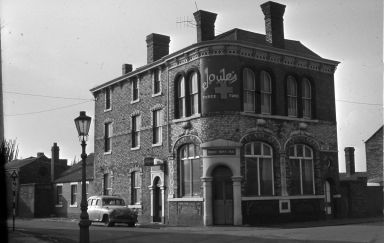
BERT BENTLEY ARCHIVE - LONGTON - 1963/64 - Three Tuns Inn. Top of Greendock Street, Longton. Junction with Edensor Road.
The road was also the location of the Meynell Arms, which in 1878 hosted the Longton, Woodhouse and Dresden Flower and Horticultural Society flower show. Similar shows also took place at a perhaps more famous pub in the same road: the Three Tuns.
I always think that the name of a hostelry on someones memorial stone underlines the one-time status in society of said pub. Sure enough, if you visit Longton Cemetery in Spring Garden Road, youll find Edwin Nicklin resting beneath the turf. Edwin, of the Three Tuns Inn, Edensor Road, Longton who died in 1926.
How many present-day Longtonians recall drinking in the Three Tuns, a one-time Joules hostelry? I visited this deceptively-large pub at Christmas, 1998. It was probably everything I had expected or even feared from a back-street Longton boozer, boasting several framed pictures of bygone Longton as well as a composite illustration of Stoke City players during Joe Jordans spell as manager. The thud-thud-thud of loud background music hardly seemed appropriate for a lunchtime session, and the bar incorporated a pool table. Although they can sometimes attract the wrong crowd to pubs, there was at least a coal fire in the lounge, making that part of the premises more welcoming.
Inside Shelley's in Longton
The pub was boarded up by 2010 and demolished in 2012. In 2014 The Sentinel reported that developers had won permission to build a block of flats on the old site.
Historical research is one thing, but to get the authentic feel of any city location, you need to have lived there. Anthony Birks now of Leek wrote a very informative letter to this newspaper in 2020. It constituted a rare recollection of Edensor Road as it had once been: It boasted friendliness, and if, by todays standards, it lacked some comforts, it was all we knew at the time. I was born in the front bedroom of number 55, opposite the Three Tuns pub. You could see into the bar of the pub from this bedroom.
Our house was an old terraced property, originally without electricity but with gas mantels. Electricity was added in my childhood. There was no central heating, bathroom or fitted carpets and the house had one cold tap. There was a toilet up the yard with no light source until my father installed an electric light.
Anthonys grandparents kept a shop at number 69, his grandad being a boot and shoe-repairer, who in the early 1900s often repaired shoes gratis for poverty-stricken locals. Ive no doubt he was frequently in demand by the local miners, potters and brick-makers.
During my childhood, Edensor Road boasted a cinema, two pubs, a chip shop, a bookmakers shop, a boot and shoe repairer, a newsagent, a sweet and tobacconist, two grocers shops, a secondary school, a drapers shop, two derelict churches, a hardware shop plus factories and potbanks.
The cinema referred to would have been the Alexandra Picture Palace in Edensor Road which opened in May, 1911 which knew many vicissitudes before eventual closure in 1957.
Anthony continued: The place and the people hold good childhood memories, playing football, cricket, scramble riding on pushbikes on the bass banks by the marl hole, jumping carties over Goms Mill Brook, racing pushbikes around a track, as a teenager playing snooker the list goes on.
The Three Tuns pub in Edensor Road, Longton, in 1995 (Photo: Norman Scholes)(Image: Norman Scholes)
Among the photographs supplied by Anthony was one of the junction of Edensor Road with Greendock Street, looking towards Cook Street and Commerce Street. It showed William Brammalls engineering company.
The firm had a long history, advertising itself by 1930 as an automobile engineer operating at the Nelson Works, Edensor Road and ultimately closing, it seems, in 1984.
Edensor Road is famous and even infamous for one other well-remembered aspect of North Staffordshire history. The Alexandra cinema building did not go gently into the night. In fact, it raved on into the wee small hours in its later incarnation of Shelleys nightclub. It is frequently stated to be much-missed, but was blighted by anti-social behaviour and police opposed the renewal of its licence.
In 1994, The Sentinel carried a photograph of Shelleys demolished and reduced to a pile of rubble but nevertheless reminding us of the days when ravers from all over England, Scotland and Wales descended on this unassuming Longton backstreet.
Choose The Sentinel as a 'Preferred Source' on Google News for quick access to the news you value.
 [Google Preferred Source Badge]
At Reach and across our entities we and our partners use information collected through cookies and other identifiers from your device to improve experience on our site, analyse how it is used and to show personalised advertising. You can opt out of the sale or sharing of your data, at any time clicking the "Do Not Sell or Share my Data" button at the bottom of the webpage. Please note that your preferences are browser specific. Use of our website and any of our services represents your acceptance of the use of cookies and consent to the practices described in our Privacy Notice and Terms and Conditions.
Accept| Web Proxy Viewer | New URL | Original Page |




![[The Sentinel]](https://www.stokesentinel.co.uk/nav-web-static/main-1203a175ed6ce47e924c82721a3f0ba020eab5f8/public/assets/stokesentinel/logos/masthead-stokesentinel-default.svg)
![[Stoke-on-Trent Live Icon]](https://www.stokesentinel.co.uk/assets/icons/stoke-sentinel.svg)
![[0_JS315561204.jpg]](https://i2-prod.stokesentinel.co.uk/article9499031.ece/ALTERNATES/s1200f/0_JS315561204.jpg)
![[0_PAS_STO_110321MORGAN_015JPG.jpg]](https://i2-prod.stokesentinel.co.uk/article5141455.ece/ALTERNATES/s1200e/0_PAS_STO_110321MORGAN_015JPG.jpg)
![[0_226-12.jpg]](https://i2-prod.stokesentinel.co.uk/article4033469.ece/ALTERNATES/s1200e/0_226-12.jpg)
![[Inside Shelley's in Longton]](https://i2-prod.stokesentinel.co.uk/article1948337.ece/ALTERNATES/s1200e/2_shelleys2.jpg)
![[2_JS335695784.jpg]](https://i2-prod.stokesentinel.co.uk/article9499030.ece/ALTERNATES/s1200e/2_JS335695784.jpg)
![[Google Preferred Source Badge]](https://www.stokesentinel.co.uk/_next/image?url=%2Fgoogle-preferred-source-badge-dark.png&w=640&q=75)
![[Ipso logo]](https://www.stokesentinel.co.uk/footer/ipso.svg)
![[trust project logo]](https://www.stokesentinel.co.uk/footer/trust-project.svg)
![[reach logo]](https://www.stokesentinel.co.uk/_next/image?url=%2Fnav-web-static%2Fmain-1203a175ed6ce47e924c82721a3f0ba020eab5f8%2F_next%2Fstatic%2Fmedia%2Flogo-reach.18f672b1.png&w=384&q=75)